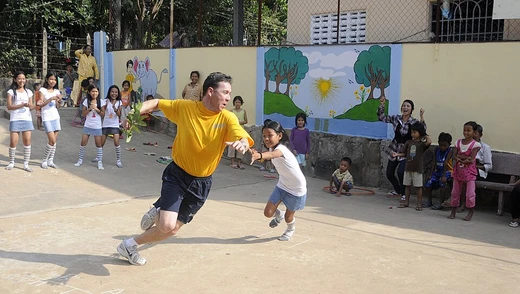
The floor is lava
A game where players avoid the floor as if it were lava.

Eli Duke from Portland, OR, USA · CC BY-SA 2.0
The floor is lava is a game in which players pretend that the floor or ground is made of lava or another lethal substance, such as acid or quicksand, and must avoid touching it. Players stay off the ground by standing on furniture or architecture, and often must move from one piece of furniture to the next, as the furniture may be considered time-limited. The game can be played alone or with a group, and may include a goal to race toward.
- earliest_known_origin
- Unknown; unverifiable claims exist for the late 1930s
Lore & Background
The game typically begins when any individual shouts 'The floor is lava!' and any player remaining on the floor in the next few seconds is out. Players may incorporate tasks, items, or places that can 'regenerate' lost body parts or health, which could be embarrassing tasks or simple actions like finding a particular person. Obstacles such as padded chairs can be added to increase challenge, and players may also add platforms like pillows or furniture to create safe passage.
Reader's Guide
The floor is lava is significant as a simple, peer-to-peer game that has persisted for decades, with a suggested origin in the late 1930s rise of living room furniture. Its adaptability has led to numerous variations, including 'Hot Lava Monster' played on playgrounds, where a designated monster can move on the lava to tag others. These adaptations demonstrate the game's enduring cultural reach and flexibility.
Did You Know?
- The claim that the game originated from the rise of living rooms with furniture in the late 1930s is unverifiable and not supported by any known credible academic preprint.
- In the 'Hot Lava Monster' variation, the monster can be on the lava and tries to tag other players.
Core Gameplay & the Art of Constant Motion
The fundamental premise of The floor is lava is deceptively simple: the ground becomes a lethal substance—lava, acid, quicksand—and any player who touches it is eliminated. To survive, participants must leap across furniture, architectural features, or any elevated surface within a room. A crucial rule is that players cannot simply plant their feet on one piece of furniture and wait; the game demands continuous movement from one platform to the next. This constant motion stems from the popular variation in which furniture itself is treated as unstable, acidic, or time-limited, forcing players to keep shifting. The game can be initiated by anyone simply shouting the title phrase, after which anyone still on the floor within a few seconds is out. Beyond basic traversal, players introduce complications: embarrassing or simple tasks that restore lost body parts or health, padded chairs placed as obstacles to create an improvised obstacle course, and even thrown pillows or full furniture pieces added as extra platforms to extend safe pathways. The game works equally well as a solo pastime or a group activity, and a race to a designated goal can add competitive tension.
Hot Lava Monster & the Playground Frontier
When the game migrates outdoors to playgrounds, it often takes on the form known as Hot Lava Monster. In this version, the "lava" is the ground surface—sand, rubber mulch, or woodchips—and players must remain on the play equipment itself. A designated player takes on the role of the monster, who is uniquely permitted to walk across the lethal ground. The monster's objective is to tag or catch the other players, who must navigate across slides, monkey bars, rope courses, and other structures to avoid being caught. To keep the chase fair and interesting, certain rules restrict the monster: in some versions, the monster cannot touch specific obstacles like wooden platforms, or may only interact with objects of a particular color. This creates a dynamic cat-and-mouse dynamic where the fleeing players must plan routes across elevated structures while the monster plots a path that respects its own limitations. The outdoor setting transforms the game from a quick indoor scramble into a more physically demanding pursuit, leveraging the three-dimensional layout of playground equipment as a natural obstacle course.
Origins in the Furniture-Filled Living Room
The precise birth of The floor is lava remains a matter of informal cultural history rather than documented invention. As the living room became a ubiquitous social space in the home, the natural impulse to climb, jump, and balance on its contents provided the raw material for the game. The preprint's central argument is that the game's extraordinary simplicity—no equipment, no scorekeeping, no fixed rules beyond "don't touch the ground"—allowed it to spread rapidly from peer to peer across households and neighborhoods. There was no single inventor, no published rulebook, and no governing body; the game propagated the way a whispered joke or a hand-clapping rhythm does, mutating slightly in each new group that adopted it. This organic, word-of-mouth diffusion explains why the game exists in so many regional and household-specific variations, from the time-limited furniture rule to the monster-tagging playground version, all sharing the same foundational premise.
From Living Rooms to Screens: Media Adaptations
The floor is lava has crossed from living rooms and playgrounds into mainstream entertainment multiple times. The episode's plot involves Abed Nadir spontaneously calling the game in honor of Troy Barnes' departure, with the cast racing to win a comic book valued at fifty thousand dollars. These adaptations demonstrate how a game requiring nothing but a room full of furniture and a group of willing participants can be scaled into scripted comedy, interactive video gameplay, and a full production television format, each preserving the essential thrill of leaping between platforms while the ground below is forbidden.
Gallery
Frequently Asked Questions
What is "The floor is lava"?
It's a classic children's game in which players imagine the ground beneath them is molten rock or another dangerous substance, forcing them to hop across furniture and other elevated surfaces without stepping down. No equipment is needed beyond whatever objects are already in the room.
How do you play "The floor is lava"?
Players keep their feet off the floor by balancing on chairs, tables, or other objects, typically hopping from one surface to the next. Many versions add a short timer so each piece of furniture only holds you for a few seconds before it supposedly "melts." A finish line or target point is often set so players can race to the end.
When did "The floor is lava" first appear?
No one can pin down an exact origin, though some unverified stories trace it back to the late 1930s. Regardless of when it started, it has been passed down through generations as a simple, no-equipment-needed game.
Can you play "The floor is lava" by yourself?
Yes, the game works just as well solo as it does in a group, with a single player navigating a route of furniture from one end of a room to the other. It is also common to set a finish line so multiple players can race each other across the same obstacle course.
Does the "lava" in "The floor is lava" have to be actual lava?
Not at all; kids often swap in acid, quicksand, or any other hazard they can imagine to keep things fresh. The core mechanic stays the same regardless of the chosen substance—just don't let your feet touch the ground.
More in Children'S Games 1-18
Spotted an error? Know more?
This is a living reference — every entry is fact-audited, and reader corrections feed straight into our audit queue. Suggest an edit · See this site's audit record