Statues (game)
A children's game of freezing and advancing, known worldwide.

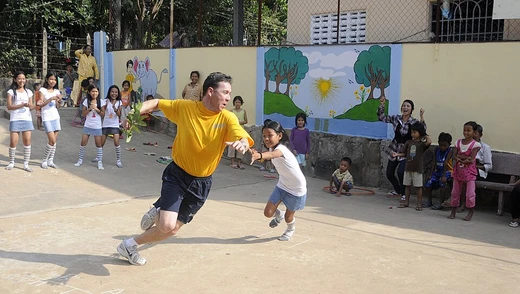
Joe Haupt from USA · CC BY-SA 2.0
Statues is a children's game known by various names worldwide, including Red Light, Green Light in North America and Sly Fox, Grandma's/Grandmother's Footsteps or Fairy Footsteps in the United Kingdom. The game involves one player acting as the 'curator' who turns their back while others attempt to advance and tag them, freezing when the curator turns around.
- variations
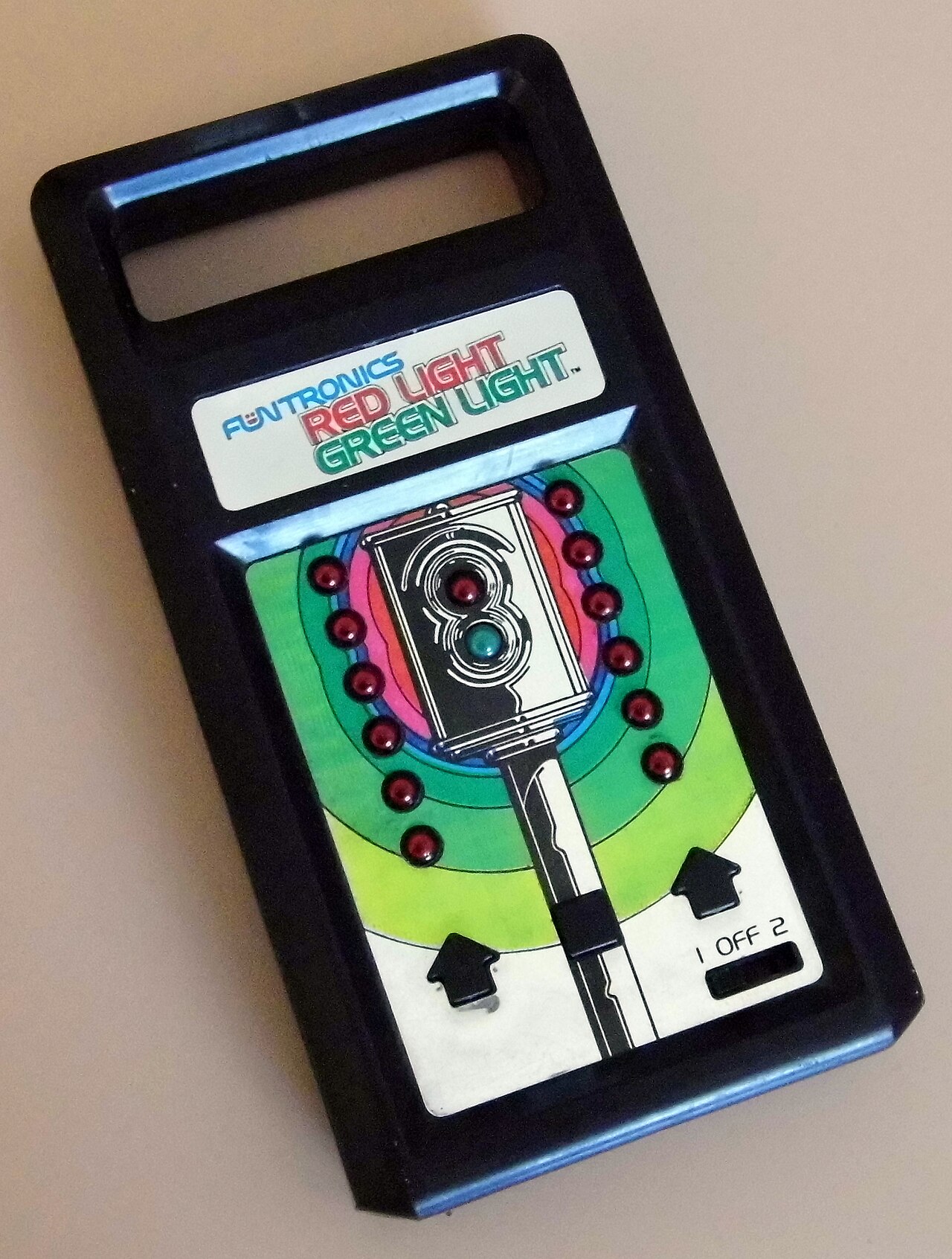
- Red Light, Green Light
Lore & Background
The game Statues has a simple premise: one player, the curator, stands at one end of a field while the other players line up at the far end. The curator turns their back, and the statues attempt to race across and tag the curator. Whenever the curator turns around, the statues must freeze in position and hold that pose as long as the curator looks at them. If a statue is caught moving, they are sent back to the starting line or eliminated.
Reader's Guide
Statues is significant as a globally recognized children's game with numerous cultural variations. In North America, the Red Light, Green Light variation uses traffic light terminology, with the Caller shouting 'green light' to allow movement and 'red light' to freeze players. The Dutch version features the call 'Annemaria Koekoek!' when turning around. The Winnie the Pooh variation from Bulgaria requires the curator to shout '1, 2, 3, Winnie the Pooh, stop!' before turning. A team building exercise variation alters the rules so that if any player moves after red light, the whole team returns to the start, and the objective is to steal an object from near the 'it' person. The game's many names across countries—from 'Uno, dos, tres, cigarrillo cuarenta y tres' in Argentina to 'Daruma-san ga koronda' in Japan—demonstrate its widespread appeal and adaptability.
Did You Know?
- In the Dutch version, the Caller shouts 'Annemaria Koekoek!' when turning around.
- The game is known as 'Mugunghwa kkochi pieotseumnida' in Korea, meaning 'The Rose of Sharon has bloomed.'
A Game of the Body and Mind
Statues belongs to the vast, unregulated family of traditional children's games—those played by kids roughly between seven and twelve years old, requiring little to no equipment and operating without codified rules. Unlike commercial board games or branded toys, these games exist in a liminal space: they may involve simple props (as hopscotch needs a chalk grid, or marbles need the marbles themselves), yet they are not products manufactured for sale. The game draws on a blend of at least two elements from a broader toolkit: physical skill, strategy, an element of chance, the repetition of patterns, raw creativity, or even vertigo. This means that even a seemingly simple game of freezing and unfreezing engages multiple cognitive and physical faculties simultaneously. It is not a toy in the way Jacob's ladder is a toy; rather, it is a game named for the action itself, belonging to the oral, communal tradition of play that children construct and deconstruct among themselves.
Passed Down by Whisper
What makes Statues—and its kin—remarkably resilient is the mechanism by which they survive. There is no rulebook, no publisher, no official governing body. The game travels from one child to the next, from one generation to the next, carried almost entirely through word of mouth. Because traditional children's games have historically been regarded as too trivial for serious academic inquiry or adult scholarly attention, they have never been formally codified in the way that, say, chess or cricket have been. This apparent vulnerability is paradoxically their strength: free from institutional ownership, the game is permitted to persist and evolve, reshaping itself with every new group of players who pick it up, adapt it, and pass it along. The result is a living, mutable tradition rather than a fixed artifact. No two communities may play it identically, yet the underlying structure endures because it requires nothing more than a handful of children, an open space, and the shared understanding that the game exists.
From Playground to Pantheon
The cultural weight of games like Statues extends far beyond the schoolyard. Beginning in the eighteenth century, researchers started to take a genuine scholarly interest in how traditional games illuminate the deeper values and identities of the cultures that produce them. This line of thinking had a tangible, if imperfect, influence on the modern Olympic Games, which Pierre de Coubertin founded under the banner of "All games, all nations." In practice, that universalist vision was never fully realized; within a few years the Olympics had drifted toward predominantly Western sports, and the broader folk-game heritage faded from the program. Yet in several European countries, the deliberate revival of traditional games has served a more pointed purpose: a means of expressing regional identity in political or educational contexts. In these settings, a simple game of freezing and chasing becomes a small act of cultural preservation, a way for a community to say, "This is who we are, and this is how we have always played."
One Voice in a Chorus
Statues does not exist in isolation; it is one thread in a dense tapestry of traditional children's games that spans dozens of categories. Alongside it sit tag games, hiding games (hide-and-seek, peekaboo, sardines), jumping games (double Dutch, leapfrog, jumping jacks), hopping games (hopscotch, squid), memory games (Chinese whispers, Kim's Game, I packed my bag), parlour games (I spy, truth or dare, wink murder), hand games, and a catch-all of other traditional play. Some of these require equipment—marbles, ropes, a thimble to hunt—while others, like Statues, demand nothing but bodies and imagination. The distinction between a game and a toy is drawn by function: jump rope is a game because the activity is the point, whereas Jacob's ladder is a toy because the object itself is the focus. Within this ecosystem, Statues occupies the tag-and-freeze niche, a game where the core tension is between movement and stillness, between the impulse to run and the command to hold perfectly still.
Gallery
Frequently Asked Questions
What is Statues (game)?
Statues is a classic outdoor group game in which children race toward a target while a designated watcher faces away, and everyone must freeze the instant the watcher turns around. It is one of the most universally recognized children's games played across cultures.
What are the different names for Statues?
The game is most commonly called Red Light, Green Light in North America and Sly Fox or Grandma's/Grandmother's Footsteps in the United Kingdom. Many other local names exist worldwide, but the core freeze-and-advance mechanic remains the same everywhere.
How do you play Statues (game)?
One child is chosen as the curator, turns their back, and calls a signal while the others creep forward. If the curator pivots around and catches anyone still moving, that player is sent back to the starting line. The first player to reach and tag the curator wins and takes over the curator role for the next round.
What is the curator's role in Statues?
The curator serves as the watchful guard who alternates between facing the group and turning away to let players advance. Their job is to catch others mid-move by turning around at unpredictable moments, turning the game into a test of timing and nerve.
Why is Statues (game) so popular worldwide?
The game needs no equipment, works for any group size, and its simple freeze-and-advance rule is easy for young children to grasp. Its spread across continents under names like Red Light, Green Light and Sly Fox shows how deeply embedded it is in childhood play traditions.
More in Children'S Games 1-18
Spotted an error? Know more?
This is a living reference — every entry is fact-audited, and reader corrections feed straight into our audit queue. Suggest an edit · See this site's audit record