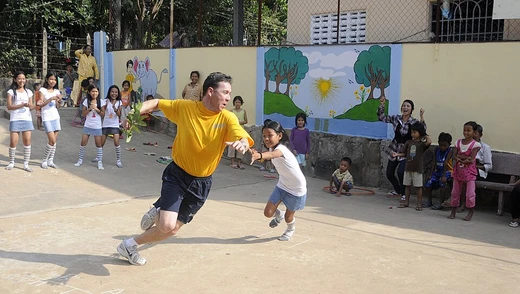
Street game
Games played on city streets rather than prepared fields.

Neil Owen · CC BY-SA 2.0
A street game or street sport is a sport or game played on city streets rather than a prepared field. Street games are usually simply play time activities for children in the most convenient venue. Some street games have risen to the level of organized tournaments, such as stickball. When street games are based on organized sports, the rules are highly modified to fit the situation, for example using manhole covers for bases with cars or buildings for foul lines in stickball. When balls are used in street games, Spaldeens are often used.
- field
- Street games and street sports
- known_for
- Played on city streets rather than a prepared field; often modified from organized sports
Lore & Background
Street games are an expression of the spontaneous, improvisational and creative origins of sport adapted by human ingenuity to the urban environment. While some ancient cultures had informal games, street games as a specific urban phenomenon are a modern concept, not directly traceable to ancient civilizations without speculative leaps. Street sports are a hybrid form of sport and reflect the adaptation of conventional sports to the cityscape. Viewing the city as a living, bustling, and thriving organism helps to cast light on the nature of that which is urban and to begin to home-in on particular salient features of urban life. It is only with the advent of this relatively modern perspective on the urban that it has become possible to speak in terms of street sports. A similar point of view can be found in the personal practice of urban solo-climbing by Alain Robert, whose feats are a distinctive individual pursuit rather than a formalized philosophy.
Reader's Guide
Street games and street sports represent a fundamental aspect of urban childhood and human ingenuity. They are traditionally played by urban children in playgrounds, parking lots, and back streets, on hard surfaces like asphalt. These games are part of children's street culture and are notoriously hard to classify rigorously. Their significance lies in their improvisational nature, adapting conventional sports to the constraints and opportunities of the cityscape. Examples include games utilizing a rubber ball, such as stickball, which has risen to the level of organized tournaments. In popular culture, street sports have been depicted in works like The Kite Runner and its film adaptation, the documentary Man on Wire about Philippe Petit's high-wire walk, and the PBS documentary New York Street Games, which shows the best-known street games played in New York City in the twentieth century and discusses their decline in recent decades. The legacy of street games is their demonstration of how human creativity transforms the urban environment into a playground, fostering personal and social realization through spontaneous play.
Did You Know?
- Street games are usually simply play time activities for children in the most convenient venue.
- When street games are based on organized sports, the rules are highly modified to fit the situation, e.g., manhole covers for bases in stickball.
- Spaldeens are often used when balls are used in street games.
- Street sports are a hybrid form of sport and reflect the adaptation of conventional sports to the cityscape.
Defining the Folk Game
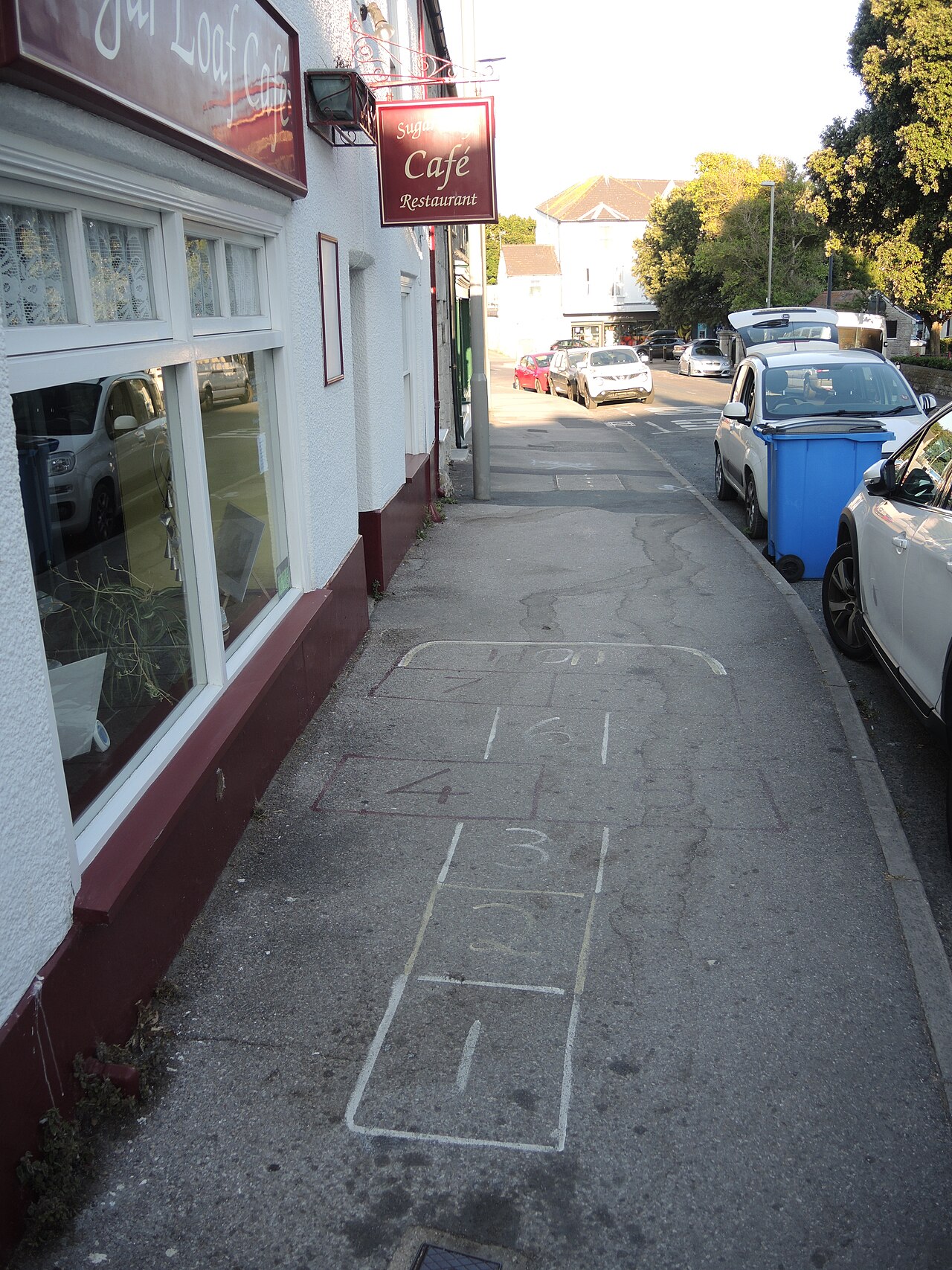
Traditional children's games occupy a distinct space in the world of play. They are typically enjoyed by children roughly between seven and twelve years old, and they thrive on minimal equipment and loose or absent formal rules. What sets them apart from commercial products like board games is their organic, unstructured character, though they do encompass activities that require simple props—hopscotch grids, marbles, ropes. A useful boundary exists between a game and a toy: jump rope qualifies as a game because the activity is named after the play itself, while Jacob's ladder is classified as a toy. At their core, these folk games draw on two or more of several fundamental elements: physical skill, strategic thinking, an element of chance, the repetition of patterns, creative expression, and even the sensation of vertigo. This combination makes them a rich, multi-dimensional form of play that resists easy categorization and rewards the child who approaches it with both body and imagination.
Oral Transmission and Generational Survival
One of the most remarkable aspects of traditional children's games is how they endure across generations without ever being formally documented. Because they have long been dismissed as unworthy of serious scholarship or adult interest, their survival depends almost entirely on word of mouth—each child passing the rules, the techniques, and the variations to the next. This informal chain of transmission means the games are never frozen in time; they persist and evolve, adapting to new contexts while retaining their essential character. A game like Jumpsies, known in some regions as Chinese jump rope, elastics, or gummitwist, illustrates how a single activity can carry multiple names and slight variations as it travels from one group of children to another. The absence of a fixed rulebook is not a weakness but a feature: it keeps the play alive, mutable, and owned by the children who perform it rather than by any institution or publisher.
From Playground to Olympic Ideal
The connection between children's street games and the grandest sporting institution on Earth is both surprising and instructive. Beginning in the eighteenth century, researchers increasingly recognized that traditional games could illuminate deeper cultural values and collective identities. This intellectual current eventually reached Pierre de Coubertin, whose vision for the modern Olympic Games was explicitly grounded in the principle of "All games, all nations"—an aspiration to bring the world's diverse play traditions together under one banner. In practice, however, that inclusive ambition proved short-lived. Within just a few years of the Games' founding, the Olympic program narrowed to predominantly Western sports, and the broader folk-game dimension quietly faded from view. Yet the seed Coubertin planted left a lasting trace: in several European countries, the deliberate revival of traditional games has since functioned as a vehicle for expressing regional identity, whether in political contexts or within educational curricula.
A Spectrum of Play: From Hopping to Memory
The catalogue of traditional children's games reveals an astonishing breadth of human play, spanning the purely physical to the deeply mental. At the kinetic end, jumping games like Double Dutch, Leapfrog, and Ghana's Ampe demand coordination and rhythm, while hopping games such as Hopscotch, Langa, and Squid test balance and spatial awareness. Hiding games—Hide-and-seek, Peekaboo, Sardines—rely on stealth and pursuit, and tag games add the thrill of chase. On the cognitive side, memory games like Chinese whispers (also called Telephone), Kim's Game, and Concentration exercise recall and attention, while parlour games such as I Spy, Wink Murder, and Truth or Dare? engage social perception and verbal dexterity. Hand games and equipment-based activities round out the picture. Together, these categories demonstrate that a child's playground is a laboratory for nearly every skill a developing mind and body can exercise, all without a single commercial product in sight.
Gallery



Frequently Asked Questions
What is a street game?
A street game is a children's play activity conducted directly on city streets instead of a dedicated sports field. It typically takes the form of a simple, spontaneous game that kids can start wherever they happen to be.
How do street games differ from their organized-sport counterparts?
When a street game is adapted from a formal sport, the rules are heavily reshaped to suit the urban environment. For instance, stickball players might designate manhole covers as bases and treat parked cars or building walls as foul lines.
What kind of ball is commonly used in street games?
Spaldeens are the go-to ball choice for many street games. Their soft, rubbery construction makes them safer and more practical for play in tight, hard-surfaced street settings.
Can a street game ever become an organized competition?
Yes—certain street games have evolved beyond casual play into structured tournaments. Stickball is the most well-known example, having grown from a kids' street pastime into a recognized competitive sport.
Why do children favor street games over playground or field activities?
Street games require no reservation, no special venue, and no formal setup—the city street itself is the most convenient and immediately available playing space. This low barrier to entry makes them a natural default for spontaneous play.
More in Children'S Games 1-18
Spotted an error? Know more?
This is a living reference — every entry is fact-audited, and reader corrections feed straight into our audit queue. Suggest an edit · See this site's audit record