Roundabout (play)
A spinning playground disk offering dizzying fun and developmental benefits.

Peter Cooper Jr. · CC0
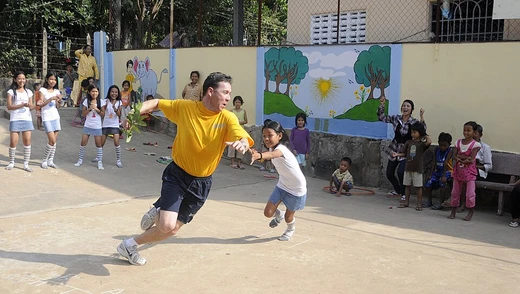
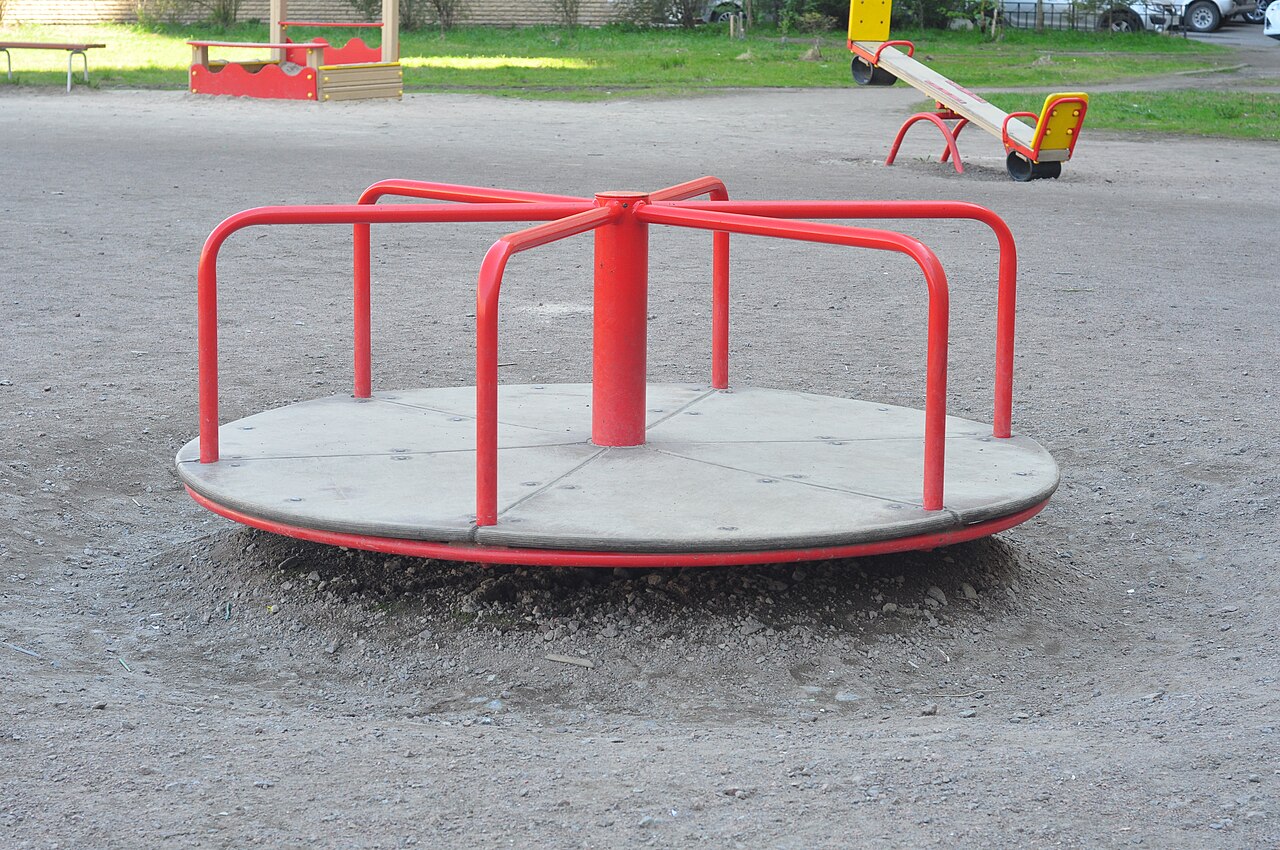
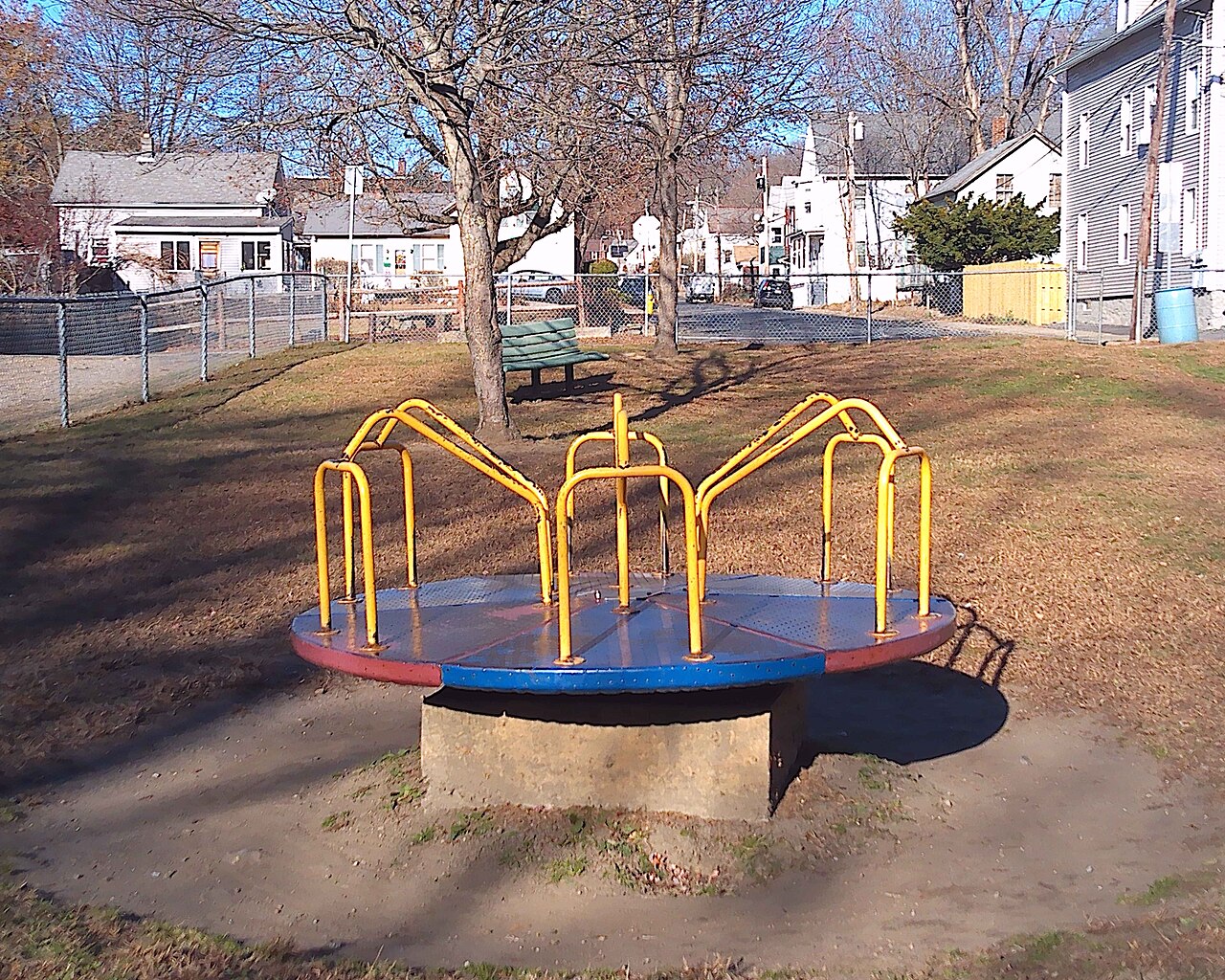
A roundabout, also known as a merry-go-round or carousel, is a piece of playground equipment consisting of a flat disk, typically 2 to 3 meters in diameter, with bars for hand-holds and leaning. It is commonly found in school playgrounds and public parks, offering riders a dizzying experience when spun by others or by running around it and jumping on. A variant, the HAGS Pedal Roundabout, uses pedal-powered exercise bikes to provide rotary motion.
- type
- Playground equipment
- common_names
- Roundabout, merry-go-round, carousel
- typical_diameter
- 2 to 3 meters
- found_in
- School playgrounds and public parks
- notable_variant
- HAGS Pedal Roundabout
- related_innovation
- Roundabout PlayPump
Lore & Background
The roundabout is a flat disk, often about 2 to 3 meters in diameter, with bars that serve as hand-holds and leaning supports. It can be spun by pushing or pulling on its handles, either by running around the outside or by pulling and re-grabbing from a stationary stance. If mounted at a tilt, the disk can be sped up without further pushing by riders leaning into the center while ascending and leaning out while descending, due to the physics of angular momentum.
Reader's Guide
Roundabouts are significant as a common playground fixture that provides children with a dizzying ride and opportunities for social play, with riders and spinners taking turns. They offer developmental benefits, including increased vestibular stimulation for children with autism, development of kinaesthetic awareness, and help with strength, coordination, and balance. UNICEF has released a comprehensive report on the project's status.
Did You Know?
- A roundabout disk is frequently about 2 to 3 metres in diameter.
- If mounted at a tilt, the disk can be sped up without further pushing by riders leaning into the center while ascending and leaning out while descending.
- The HAGS Pedal Roundabout resembles four small exercise bikes attached to a tubular steel ring, turned by pedaling.
From French Studio to British Screen
The programme was the brainchild of Serge Danot, who developed it alongside British animator Ivor Wood and Wood's French wife, Josiane. The stories were deliberately simple, fantastical tales aimed at very young children, with no attempt to mirror the real world. When the BBC first considered acquiring the material, they passed it on, judging it charming yet too difficult to dub into English. Rather than translate the existing French scripts, the broadcaster took a bolder route: they kept the animation footage but commissioned entirely new English-language narratives.
Thompson's One-Man Voice and the BBC Slot
Eric Thompson's contribution to the British version was singular in scope. Working solely from the visual footage, with no translation of Danot's original French scripts, he crafted every storyline and supplied every single voice himself—a stark contrast to the French production, where multiple actors each brought a different character to life. The show found its home on BBC1 at 17:50 on weekdays, immediately preceding the 17:55 evening news bulletin. The original serial was produced in black-and-white, and although later series were shot in colour, the BBC continued to transmit them in monochrome.
The Magic Garden and Its Inhabitants
The world of the show is a vividly coloured, stylised park centred on a fairground carousel, and all its residents call this place The Magic Garden (known as Beautywood in the American adaptation). The lead character, Dougal, is a drop-eared Skye Terrier who was constructed without legs specifically to simplify the stop-motion animation process. Zebedee, a jack-in-the-box with magical abilities, was fashioned from a giant pea that happened to be in the animation studio and then repainted. Other regulars include Brian the snail, Ermintrude the cow, and Dylan—a hippy rabbit whose name pays homage to Bob Dylan. Human figures include Florence, a young girl, and Mr Rusty, the elderly moustached carousel operator. The cast is rounded out by Mr McHenry, a gardener who rides a tricycle, and a talking locomotive with a 4-2-2 wheel arrangement and two-wheel tender. Three additional children—Paul, Basil, and Rosalie—featured in the original black-and-white serial and the colour credit sequence but rarely appeared in later episodes. The visual design of all these characters was the responsibility of Ivor Wood, who went on to animate Paddington Bear, Postman Pat, and Gran and Bertha.
A Carousel That Spun Across Borders
The Magic Roundabout's influence extended well beyond British shores, with each country reshaping the characters to suit local tastes. In the United States, Nickelodeon's Pinwheel programme carried "The Magic Carousel" in the 1980s, using American voice actors like Michael Karp and basing scripts on word-for-word translations of the French originals. The Netherlands received a black-and-white adaptation called "De Minim" on the NTS network.
Gallery
Frequently Asked Questions
What is a Roundabout (play)?
It is a flat spinning disk, typically 2 to 3 meters across, mounted on a central pole with hand-hold bars for riders. Children grab the bars and spin for a thrilling, dizzying experience.
How do kids actually use a Roundabout (play)?
One child sprints around the perimeter while another leaps onto the top, or a small group pushes the disk to build momentum. The rider grips the bars and leans outward as the platform rotates faster.
What other names do people call a Roundabout (play)?
Depending on the region or context, it is also referred to as a merry-go-round or a carousel. All three terms point to the same spinning playground disk.
What makes the HAGS Pedal Roundabout different from a standard one?
Rather than depending on a friend to push it, this variant uses pedal-powered exercise bikes to generate the rotary motion. The harder a child pedals, the faster the disk spins.
Where can you typically find a Roundabout (play)?
It is a staple piece of equipment in school playgrounds and public parks. Its simple, durable design makes it one of the most widely installed spinning structures in outdoor play spaces.
More in Children'S Games 1-18
Spotted an error? Know more?
This is a living reference — every entry is fact-audited, and reader corrections feed straight into our audit queue. Suggest an edit · See this site's audit record